Tuesday, August 25, 2009

Urban Form and Zoning


After a two week excursion to my beloved Duke City, I am armed with more ammunition to produce more blogs. Well, that and I also have a week of downtime before embarking on another adventure in urban design and planning.

I had the opportunity to ride the Rail Runner to Santa Fe, visit family on the northwest mesa, bike ride along Tramway, ride the new Rapid Ride 777 bus as well as the 66 along all of East Central, and walk around downtown, Nob Hill, and Uptown. My observations reveal a growing distaste for the attention to form around our city, unfortunately. I want to note that I see positive signs for the future, particularly through UNM's design studios and various citizen groups.

Yahoo! displayed Albuquerque as the travel destination on my homepage. Taken from Rough Guides, "Like Phoenix, it's grown a bit too fast for comfort in the last fifty years, but the original Hispanic settlement is still discernible at its core, and its diverse, cosmopolitan population gives it a rare cultural vibrancy. Even if its architecture is often uninspired, the setting is magnificent, sandwiched between the Rio Grande – lined by stately cottonwoods – and the dramatic, glowing Sandia Mountains."

As a resident, the cultural vibrancy becomes apparent and the built environment becomes less important, I think. My two year absence, however, has somehow allowed these details to amplify.

I have seen the sector plans which call for density along "Centers and Corridors," per the Comprehensive Plan. But what centers and corridors are they referring to? A UNM design studio just completed some design work for the International District on East Central. But there is a new sign and construction for a suburban style CVS at the intersection with Louisiana. The downtown 2010 plan adopted nearly a decade ago calls for form-based codes which dictates that no buildings within the boundary shall be designed with such set backs and parking lots. However, just over the boundary along Broadway, they have built a drive-thru Starbucks and Carl's Jr. The city took it to a whole new level and created a giant retention pond at the gateway to downtown complete with chainlink fencing. Does no one at the city see this? The head planner, the architects, engineers.....anybody?

I've slowly begun to understand the connection (or lack thereof) between the entities involved in the making of these decisions. The fact is, there is no connection, or communication, between the entities. In an effort to reduce traffic congestion, traffic engineers have been given the green light to run the show. Clearly, these engineers have little to no understanding of their influence on the way we live. They live within the boundaries of their code books and traffic analysis which, till recently, was the full extent of their duty. However, the times are changing as they say. Universities are beginning to realize the error in this approach by teaching young professionals to reach consensus across disciplines. This technique has begun to save the construction industry huge sums of money by eliminating the extraneous coordination efforts required after construction has begun. Clearly our city's planning department has not heard of such methods. Ironically, today there was a post at Duke City Fix which touches on this topic with discussion about the much-needed pedestrian crosswalks in Nob Hill. Mike Riordan's apparent arrogance regarding his knowledge of the "criteria" to achieve such ends is emblematic of the attitude at city hall and the planning department.

Meanwhile, Denver continues to pave the way in progressive development practices. They have been the posterchild for urban revitalization for nearly two decades now as well as for mass transit (light rail AND streetcars). Architectural Record featured them in an article about their latest approach to zoning and the urban form. They are in the process of implementing form-based codes citywide. Albuquerqueans are adamant about blazing their unique path and being unique, but other cities are actually taking action in proactively planning and coordinating their futures. These can provide wonderful lessons and ideas that can aid in shaping the way we plan. It's our duty to make sure our leaders are getting the message...and if they're not, we need individuals in charge who will.

Thursday, August 13, 2009

Choo Choo to the City Different


I finally had the chance to catch the bird to Santa Fe. My trip began with a bus ride down Central on the 66 bus. I boarded the bus at 9:20am at the Juan Tabo stop with my destination being 1st and Central across from the ATC. I want to note that I am still stunned by how busy this bus route was in the middle of the morning. It was approximately half full when I boarded but it was essentially full once we picked up passengers at Wyoming.

When I reached my stop and deboarded, I was again surprised by the rather large crowd awaiting the RailRunner 30 minutes before departure. Impressive!


An hour and a half (or so) later, we finally arrived at the Santa Fe Depot. I'm so impressed by the transformation that has taken place in the area. REI, Flying Star, 2nd Street Brewery, a new park, and various small businesses have all invested in the area which has resulted in quite a vital area. I even noticed some very attractive and surprisingly modern (modern in Santa Fe?!) lofts under construction in the development area. Truly mixed-use at an appropriate scale.


Sunday, August 09, 2009

Seattle's Mayor On Seattle...

"Seattle, he says, is "competing with great metropolitan areas all over the world who are very deliberately laying out their future. And if we don't learn how to make decisions and move forward, rather than debating the same issues over and over and over again, we're going to have our lunch eaten."" - Mayor Nickels in the Seattle Times

Light-rail, arena, etc., etc. Sound familiar?

This is the eve of my return trip to the 505. I can't wait!


Thursday, June 25, 2009

Ni Hao!


Greetings from Chengdu, China! First there was the finals madness followed by this 5 week excursion for school and fun. I'll provide some insight and such upon return to the states but for now I wanted to share a pic or two.

Cheers!

Tim

Saturday, May 30, 2009

The Great Paseo Brouhaha

I remember back in the early to mid 1990s when Marty was pushing through the Paseo "Freeway" to the westside. I was in middle school and so incredibly excited that our city would have another freeway. That nearly made us like a big city!

15 years later, that freeway has fed into the sprawl machine that has pushed most new growth to the northwest mesa and Rio Rancho. I say sprawl as though it were a vile word but I have to admit that I don't truly see it being the devil, per se. However, in this day and age, feeding this 20th century "solution" to growth and traffic management seems a bit naive.

The biggest cheerleader is wanna-be mayor Cadigan whose constituents, obviously, want to cross the river much quicker and dislike sitting in idling traffic. Who doesn't? Here lies my inner communist planner: these people made the decision to move to this area with limited routes into "the City" (that makes it sound cool when you say it like that), they should not be bailed out of their poor decision. Cadigan, being the enlightened individual that he wants to be, balks at the mayors attempts at investing in the stagnant downtown (see: arena, streetcar) because of budget constraints. Yet, he is aggressively pushing for a short term solution that puts us further in the hole, financially, than this "boondoggle" choo choo. I want to qualify my "short term solution" statement by forecasting an increasingly growing westside and increased commuter traffic into "the City." This growth will put us right back to our current situation but only on a larger scale. Therefore, this $250 million dollar solution is not, in fact, a solution, but a very expensive, parasitic, band aid.

When will people wake up to the world around them? Albuquerque is already tip-toeing the line of excessive bad air quality days. We're using far more water than we planned. And our educated youth are leaving in droves.

I was recently given a presentation by a Chinese planning firm that stated what everyone seems to acknowledge (even in rural, northwestern China!) - that educated young adults are swarming to cities that exhibit smart growth practices and provide rich, urban environments. These places, in turn, attract employers looking for such talent. How do our city leaders not recognize this?

Screw quality of life, we need more roads, says Michael Cadigan!

Sorry, I can't help it.

Thursday, May 28, 2009

Transportation in America

PBS recently aired a terrific show on the subject. They use New York City, Portland, and Denver as their models to compare and contrast solutions over the decades and the ramifications of those decisions. Have a look-see.

Thursday, May 07, 2009

Flooding Mitigation


My past two quarters (crazy quarter system) of education have been filled to the gills with hazard mitigation material. I won't lie, the codes and regulations bore me to tears some days. However, there is a ton of new techniques and technologies that are being employed regularly that are quite applicable universally which are exciting if you're a geek like me. (stick with me here)

For example, new forms of permeable concrete have been developed to aid in storm runoff reduction and aquifer recharge. Also, crazy (sarcasm) landscapers and engineers have learned to create parks and other attractive landscapes to double as retention ponds (hello engineers and the planning staff that designed and approved the ugly hole at Lomas and Broadway!). Even bioswales (fancy landscape architecture jargon for ditches) are being installed in urban areas to create green space and act as a natural filter for storm runoff in streets.

These techniques really add up to create a healthier environment when you consider the current, archaic methods we have used for decades. For years we have attempted to engineer our civilizations out of harms way. We design our storm drainage system to a 100-year flood capacity (in ABQ) with the belief and hope that THE big storm will never hit. We even shoot rainwater runoff down pipes (unfiltered?) to the Rio Grande!

Well, in 2006, I believe, that 100-year event hit us quite hard. Twice. Some will say, "well, obviously, it's another example of global warming." Others, "That's God blaming us for allowing gay marriages." And others, "It's a fluke, who cares?"


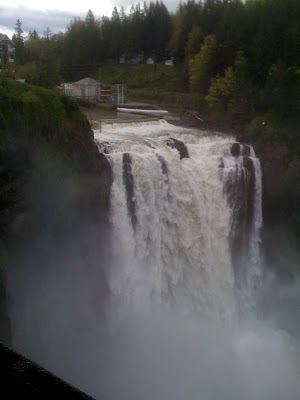
This week, I have been studying hazard mitigation in the city of Snoqualmie, WA and today we were given a tour of the tiny city by the mayor and other officials who shared their knowledge regarding the city's preparation for the next big natural disaster.

Around 10am (after the caffeine had kicked in) I began to draw parallels between what I was hearing and what I had seen in Albuquerque when the floods hit a few years back. A visitor of China asked the question, "Why did the natives of this city settle in this flood-prone area in the first place?" I sorta chuckled when he asked this. But I didn't expect to hear the answer the gentleman received. Apparently, this area was not historically susceptible to flooding until the logging industry ran amok in the surrounding mountains. Interesting. Go on you say? The forests were ravaged to such an extreme that storm runoff had increased enough to make that drastic of a change to the environment.

So, the mice in my head began to run and I thought, "Hrm, could maybe, just maybe, the runoff situation in Albuquerque be the result of an increase in urbanized area?" Could we have built up the our roadways, sidewalks, and homes to the point where we have increased runoff so that our storm system actually reaches capacity with less effort?

I don't know about you but I'm suddenly intrigued with hazard mitigation and the ways in which we can use natural processes and nature-sensitive technologies (don't I sound like a hippy?) to cure the problems we have created through naive manipulation and false confidence?

The city's form of development has been so greatly affected by homogenization and generic growth to the point where our innovation has seemingly been forgotten. But alas, there are solutions. These solutions are so very simple, yet they require everyone to change the way they were taught to do things...and that's the harddest part.

Rapid Ride


Seattle has just introduced a new fleet of BRT busses also called "Rapid Ride" with the same livery we've come to know. These would look quite sexy zooming down Montgomery, San Mateo, and Coors.

Monday, April 27, 2009

ABQ's "Burgeoning Bike Scene"

Albuquerque has been named as one of the top cities for burgeoning bike scenes! A quick rundown of the top cities and their statistics shows that we definitely have the infrastructure - nearly 400 miles worth. But we lag in percentage of commuters. Hopefully the new I-40 ped/bike bridge will help us close the gap with peer cities. The article.

Tuesday, April 21, 2009

Urban Design Fail - Lomas & Broadway

The corner of Lomas and Broadway now includes a gas station, drive through restaurants, and a dirt detention pond with surrounding chain link fence. How's that for a gateway into our revitalizing downtown? *shakes head*
KOB story link.

Thursday, April 02, 2009

BikeABQ

I am ecstatic about the bike boulevard and ped/bike bridge over the river as seen here and here. Soon we'll be talking about separated bike lanes like these. I'm thinking of Carlisle, parts of Central, parts of Lomas, 4th, and Rio Grande. Perhaps the Great Streets Facility Plan would be a perfect place to implement a test case? I find it incredible that people question the use of $7.5 million for a pedestrian/bike bridge when hundreds of millions of dollars are spent annually to subsidize oversized roadways throughout the city and particularly at the fringe. But then again, Marty isn't looking to set the record straight, he has another term to run for in the meantime. A nifty video about separated bike lanes...

Thursday, March 26, 2009

Affordable Lofts


I'm not sure how long these have been completed but I'm a little surprised they aren't filled as of yet. I only wish the developer had scrapped the parking lot and built urban townhomes along the street. Affordable for those just starting a career or looking for simple digs. Bell Trading Post Lofts

UNM On-Campus Housing


Finally, it is happening. Ok, well, not physically but the details are being ironed out according to this article. I hope they intelligently locate these buildings (hopefully multi-story, mixed-use) along Central Ave. or Lomas. The parking situation for UNM is out of control and locating dense housing near campus is key to enhancing the area in several ways. First, students who don't need to pay for automobiles will add to the vibrancy of the walkable neighborhood and take another vehicle off an already congested roadway system in the area. Also, students that don't need to pay for vehicles will have more spending money to support local businesses. Finally, this supports my desire to take over the world.

In the screenshot above, it is clear we have a horrendous pedestrian environment on the edge of our flagship university. With Nob Hill a block back and UNM retail a block ahead, this intersection screems for help. We can connect the two areas with very little effort. Locating student housing along Central in this area will go a long way toward realizing a decent pedestrian environment.

Yay for change.

Thursday, March 12, 2009

The Seattle Model


Having lived here for almost three months now, I have found it more difficult to relate the built environment of Albuquerque with the Seattle area. Dallas seemed much easier to compare. The relatively flat landscape, the pretty skyline but sleepy downtown, and the prevalence of suburban neighborhoods. Maybe it's the trees and varying geography of the Pudget Sound region? One thing that has shocked me, however, is the strong ties I have seen between my beloved Duke City and the Emerald City. First there is the empty box from Los Poblanos in the basement of my building at the UW. Next, there is the plethera of Land of Enchantment license plates. So many in fact, I'm pretty sure I have seen more NM plates here than I did when I was in Dallas. This fact shocks me considering Dallas is 1/3rd as far as Seattle. What was my point? Oh right, relationship.

Albuquerque seems to be right on the fence when it comes to economic and social issues. As a 20-something in Albuquerque, I tended to find other liberal, environmentally conscious, atheistic, gen x'ers which the Northwest is known for having in large quantities. Coupled with a rather sizable population of REI members who were ready to get out of the city to soak up some mountain and river goodness when there was free time to be had. But still, there was always an obvious presence of conservatism and almost Texas-like economic development defined by cheap land.

After my first quarter of courses, something I have learned is that a city represents the values of its inhabitants. I'm not sure how I feel about this given our overabundance of strip malls and parking lots. Our sleepy downtown. Our multi-nodal city with little to no relationship and seemingly zero planning. Too often I read about the local pride in our low density growth pattern that reflects the far-as-the-eye-can-see geography. These facts illustrate an abundance of opportunity for improvement. But what exactly are the values of the community?

While Seattle appears to be a pioneer of healthy, urban initiatives, it has quite a colorful history of political and social struggles. While the city claims to be diverse, it is similar to Albuquerque in that it's predominantly a bi-cultural city. The city actually has a quiet history of segregation. Until more recently, economic booms have tended to aid in the city's ethnic cleansing, if you will. Additionally, many people forget how spread out metro Seattle really is. The suburbs stretch north and south quite a long ways with typical low-rise sprawl. But this is hardly noticeable from the city proper where you're surrounded by dense, Capital Hill, Queen Ann hill, and the Sound. Much of this area is easily accessible by bike and by bus and much of it appears clean, safe, and again, dense.

As with every region in the country, and world, Albuquerque now has the opportunity to lay the framework for smarter, future growth in this slow economy. But this framework must be defined by the same community that has provided much of what we know as our ABQ. While the RailRunner provides the incentive and backbone for a positive shift, it remains to be seen if we've learned from our past. The knowledge of a warming atmosphere and straining natural resources exists. But will we choose a more equitable, livable, and environmentally sustainable form of development?

Models like Dallas, Denver and Seattle are prototypes for us to study our likely future. Each one of them is a dim reflection of our eventual city. So, instead of choosing to be stubborn and going through the growing pains of traffic congestion, social stratification, smog, etc., why can't we jump straight to the solutions these cities have begun to embrace?

Thursday, February 26, 2009

Santa Fe Baboons

No to domestic partnerships and yes to subsidizing sprawl. I'm not disappointed to be a resident of another state on this eve.

Monday, February 23, 2009

The International District


Jim Scarantino wrote an excellent piece in the Journal about the former "War Zone" that I believe deserves kudos. I have to credit the mayor to some extent for his effort to revitalize this neighborhood. But, ultimately, it is the residents of the International District that we should applaud. Hopefully we will see some investment from the city in terms of urban design aspects like pedestrian crosswalks, shade trees, and wider sidewalks to encourage complimentary commerce.

Friday, February 20, 2009

Casa District


I'll save my usual harangue regarding the housing/regional transit station transition and, instead, focus on the nascent district. A form is emerging that I'm, increasingly becoming fond of.
It's not the density an urban fanatic dreams about. However, the density in these three new projects will likely result in 500 or so residents within three blocks. The open, remaining half block may even be that 6-8+ story residential building we're all anxiously awaiting. My mood: hopeful.

High-Speed Rail


Ok, I feel better after my previous post. The article. Imagine a train like this parked at the ATC awaiting passengers heading to Denver.

Note there is no HSR currently planned for ABQ. Not good. It would appear that the Front Range/Intermountain West has work to complete. Missing out on this type of infrastructure would be akin to missing out on the interstate highway system.

Wednesday, February 11, 2009

Did Someone Say Shovel Ready?

Borrowed from the NY Times

Note the picture: Our savior president standing in front of the construction site for a...wait for it...parkway.

What a crock. Explain to me how sending money on projects like a third lane for I-25 will produce long term economic affects that aren't negative? Now tell me that spending stimulus money on pie in the sky projects like a streetcar or (gasp) arena won't produce lasting, positive effects? Not so pie in the sky when you boil it down. Apparently school construction isn't logical, either.

Watching our leaders salivate over this money to cover short term projects that didn't fit their anemic, annual budgets is quite embarrassing. I hope I'm wrong about this. I know there are worthy projects in this jumble but labeling this "forward-thinking" or to even comparisons to the New Deal are absurd.

Speaking of absurd, what's with the vote of no confidence for Shmidly? UNM employees appear to have trouble with change. How many leaders will they oust in an attempt to keep the status quo? (Perhaps I know too little to comment)

Saturday, February 07, 2009

Marty for Downtown and MRCOG Says What?

Image courtesy of kevinkarnsfamily

I was happy to hear Mayor Marty endorse the city center this week. I can't find the link but I either read or heard him (news clip?) suggest that it would be good to obtain funds that could be spent downtown. Not the strongest statement but we'll take what we can get. I'm certain he was referring to money for a canopy for the ATC but I'm not sure what else he might be referring to knowing that money won't come from DC for the arena or streetcar.

While the city has minuscule amounts of money funneling down from new housing construction in the 'burbs, perhaps we'll see a return of serious talk concerning inner city development and density? For some reason I'm skeptical.

During my visit over Christmas I noticed some work has been completed on the last remaining building at old AHS. Does anyone have any information about that project? I know it's not part of Rob Dickson's development.

Speaking of Rob Dickson, anyone have a clue what he's up to now that his project is fully built out?

In other news...

Now, I have ranted and raved about the Railrunner and I can't help but add more fuel to the fire. My textbook contained some information that I felt was pretty obvious but it doesn't seem to make sense to so many:

"Transit's cost effectiveness increases with higher densities at origins and destinations. It is no surprise that public subsidies for transit have increased at the same time that metro transit is not as competitive as private automobile."

"A new rail system implemented in an area laden with density caps and minimum parking requirements will have less influence on land development than such a system implemented in areas where the community wide land use design, small area plans and development management plan include actions intended to support or leverage the opportunities provided by the investment."

"transportation plans either reinforce past development trends or stimulate development in locations not contemplated in the land use plan."

After reading this I immediately thought of Nob Hill fighting a streetcar and the horrendously planned (or lack thereof) Journal Center station area.


I also often wonder who is making recommendations to add more stops to the system. I heard talk of creating an additional stop at Montano. Really? Talk of a fourth station in Santa Fe seems incredibly asinine considering the ABQ metro area currently has just 6(see population differences between SF & ABQ) stations. Throw in the pueblo stations (don't get me started on these) and we've killed the purpose of commuter rail. The chance of MRCOG actually convincing citizens to ditch their gas guzzlers in favor of the system requires a huge convenience factor. Added commuting time plus limited service is not the answer. MRCOG is mixing the concepts of commuter rail with light-rail while leaving everyone wondering what they're doing because they don't appear to have transparency in their planning nor their execution.

Overall, this in a beautiful concept and project for the metro area. But the execution is what matters most. My confidence has been shaken.

Sorry for the brain vomit style of my post.