Wednesday, August 26, 2009

Breaking Bad - Habits


Our codepedency on oil is not a healthy one. I know, you've heard it before and yes, I might sound like a crazy hippy but more and more those hippies are sounding a lot more informed than some originally thought and also more informed than a majority of our political leaders. A study that was conducted a little while back concluded what we already knew but is now presented in a nifty chart: we spend far too much time in our vehicles for a city our size and for such a rural state. These figures only show money spent on gas. It doesn't factor in the cost of owning and maintaining an automobile! The chart:

We're right behind Texas. That's right, Texas. I'm of the opinion that we shouldn't be anywhere near Texas on any lists after living there for 14 months. Their low taxation, cheap land, minimal planning, and explosive growth is rapidly catching up with them in a very negative way (see healthcare, education, transportation infrastructure, etc.). Anyway, enough of that place.

Again, our land use and low density form of development has us driving further and spending less time doing the things we enjoy. In exchange, we're polluting our air and spending hordes of money developing and maintaining an unsustainable form of infrastructure. Perhaps if we all saw the figures for how much of our income goes to roads, then maybe the alternatives wouldn't look so "outlandish."

Now, you all probably think that I want the whole city razed and replaced with high rises for everyone but it's not true. I believe low density, single-family homes are here to stay. Not everyone wants to live in an urban environment for a plethora of reasons. But our city doesn't currently provide options. Furthermore, density doesn't mean high rises. There are many building typologies that actually create densities near those associated with high rises. There are neighborhoods in our city that would adapt well to increased density.

Globalization and global warming are two looming issues that will force us to change our ways whether we want to recognize them or not. The water will dry up on all those lawns they continue to grow for every new house constructed on the west mesa. Concrete and steel prices will continue to rise as China, India, and other countries develop at an exceedingly rapid pace. High oil prices are here to stay and will only get worse. Electricity generation is required to heat and cool each and every single, unnecessarily large family home. These small facts of life are taken for granted in our country but we'll all soon be faced with crisis as we are forced to compete. It's like a business during tough economic times, you either create a leaner operating budget or send everyone home and file for bankruptcy. Right now, we're on our way to bankruptcy and we act like we don't know it.

In a poor state such as ours, we are also negatively affecting those with low incomes by forcing them to invest in automobiles so that they may 'git things done. It's asinine! I could go on all day about this but I'll stop here.

Tuesday, August 25, 2009

Urban Form and Zoning


After a two week excursion to my beloved Duke City, I am armed with more ammunition to produce more blogs. Well, that and I also have a week of downtime before embarking on another adventure in urban design and planning.

I had the opportunity to ride the Rail Runner to Santa Fe, visit family on the northwest mesa, bike ride along Tramway, ride the new Rapid Ride 777 bus as well as the 66 along all of East Central, and walk around downtown, Nob Hill, and Uptown. My observations reveal a growing distaste for the attention to form around our city, unfortunately. I want to note that I see positive signs for the future, particularly through UNM's design studios and various citizen groups.

Yahoo! displayed Albuquerque as the travel destination on my homepage. Taken from Rough Guides, "Like Phoenix, it's grown a bit too fast for comfort in the last fifty years, but the original Hispanic settlement is still discernible at its core, and its diverse, cosmopolitan population gives it a rare cultural vibrancy. Even if its architecture is often uninspired, the setting is magnificent, sandwiched between the Rio Grande – lined by stately cottonwoods – and the dramatic, glowing Sandia Mountains."

As a resident, the cultural vibrancy becomes apparent and the built environment becomes less important, I think. My two year absence, however, has somehow allowed these details to amplify.

I have seen the sector plans which call for density along "Centers and Corridors," per the Comprehensive Plan. But what centers and corridors are they referring to? A UNM design studio just completed some design work for the International District on East Central. But there is a new sign and construction for a suburban style CVS at the intersection with Louisiana. The downtown 2010 plan adopted nearly a decade ago calls for form-based codes which dictates that no buildings within the boundary shall be designed with such set backs and parking lots. However, just over the boundary along Broadway, they have built a drive-thru Starbucks and Carl's Jr. The city took it to a whole new level and created a giant retention pond at the gateway to downtown complete with chainlink fencing. Does no one at the city see this? The head planner, the architects, engineers.....anybody?

I've slowly begun to understand the connection (or lack thereof) between the entities involved in the making of these decisions. The fact is, there is no connection, or communication, between the entities. In an effort to reduce traffic congestion, traffic engineers have been given the green light to run the show. Clearly, these engineers have little to no understanding of their influence on the way we live. They live within the boundaries of their code books and traffic analysis which, till recently, was the full extent of their duty. However, the times are changing as they say. Universities are beginning to realize the error in this approach by teaching young professionals to reach consensus across disciplines. This technique has begun to save the construction industry huge sums of money by eliminating the extraneous coordination efforts required after construction has begun. Clearly our city's planning department has not heard of such methods. Ironically, today there was a post at Duke City Fix which touches on this topic with discussion about the much-needed pedestrian crosswalks in Nob Hill. Mike Riordan's apparent arrogance regarding his knowledge of the "criteria" to achieve such ends is emblematic of the attitude at city hall and the planning department.

Meanwhile, Denver continues to pave the way in progressive development practices. They have been the posterchild for urban revitalization for nearly two decades now as well as for mass transit (light rail AND streetcars). Architectural Record featured them in an article about their latest approach to zoning and the urban form. They are in the process of implementing form-based codes citywide. Albuquerqueans are adamant about blazing their unique path and being unique, but other cities are actually taking action in proactively planning and coordinating their futures. These can provide wonderful lessons and ideas that can aid in shaping the way we plan. It's our duty to make sure our leaders are getting the message...and if they're not, we need individuals in charge who will.

Thursday, August 13, 2009

Choo Choo to the City Different


I finally had the chance to catch the bird to Santa Fe. My trip began with a bus ride down Central on the 66 bus. I boarded the bus at 9:20am at the Juan Tabo stop with my destination being 1st and Central across from the ATC. I want to note that I am still stunned by how busy this bus route was in the middle of the morning. It was approximately half full when I boarded but it was essentially full once we picked up passengers at Wyoming.

When I reached my stop and deboarded, I was again surprised by the rather large crowd awaiting the RailRunner 30 minutes before departure. Impressive!


An hour and a half (or so) later, we finally arrived at the Santa Fe Depot. I'm so impressed by the transformation that has taken place in the area. REI, Flying Star, 2nd Street Brewery, a new park, and various small businesses have all invested in the area which has resulted in quite a vital area. I even noticed some very attractive and surprisingly modern (modern in Santa Fe?!) lofts under construction in the development area. Truly mixed-use at an appropriate scale.


Sunday, August 09, 2009

Seattle's Mayor On Seattle...

"Seattle, he says, is "competing with great metropolitan areas all over the world who are very deliberately laying out their future. And if we don't learn how to make decisions and move forward, rather than debating the same issues over and over and over again, we're going to have our lunch eaten."" - Mayor Nickels in the Seattle Times

Light-rail, arena, etc., etc. Sound familiar?

This is the eve of my return trip to the 505. I can't wait!


Thursday, June 25, 2009

Ni Hao!


Greetings from Chengdu, China! First there was the finals madness followed by this 5 week excursion for school and fun. I'll provide some insight and such upon return to the states but for now I wanted to share a pic or two.

Cheers!

Tim

Saturday, May 30, 2009

The Great Paseo Brouhaha

I remember back in the early to mid 1990s when Marty was pushing through the Paseo "Freeway" to the westside. I was in middle school and so incredibly excited that our city would have another freeway. That nearly made us like a big city!

15 years later, that freeway has fed into the sprawl machine that has pushed most new growth to the northwest mesa and Rio Rancho. I say sprawl as though it were a vile word but I have to admit that I don't truly see it being the devil, per se. However, in this day and age, feeding this 20th century "solution" to growth and traffic management seems a bit naive.

The biggest cheerleader is wanna-be mayor Cadigan whose constituents, obviously, want to cross the river much quicker and dislike sitting in idling traffic. Who doesn't? Here lies my inner communist planner: these people made the decision to move to this area with limited routes into "the City" (that makes it sound cool when you say it like that), they should not be bailed out of their poor decision. Cadigan, being the enlightened individual that he wants to be, balks at the mayors attempts at investing in the stagnant downtown (see: arena, streetcar) because of budget constraints. Yet, he is aggressively pushing for a short term solution that puts us further in the hole, financially, than this "boondoggle" choo choo. I want to qualify my "short term solution" statement by forecasting an increasingly growing westside and increased commuter traffic into "the City." This growth will put us right back to our current situation but only on a larger scale. Therefore, this $250 million dollar solution is not, in fact, a solution, but a very expensive, parasitic, band aid.

When will people wake up to the world around them? Albuquerque is already tip-toeing the line of excessive bad air quality days. We're using far more water than we planned. And our educated youth are leaving in droves.

I was recently given a presentation by a Chinese planning firm that stated what everyone seems to acknowledge (even in rural, northwestern China!) - that educated young adults are swarming to cities that exhibit smart growth practices and provide rich, urban environments. These places, in turn, attract employers looking for such talent. How do our city leaders not recognize this?

Screw quality of life, we need more roads, says Michael Cadigan!

Sorry, I can't help it.

Thursday, May 28, 2009

Transportation in America

PBS recently aired a terrific show on the subject. They use New York City, Portland, and Denver as their models to compare and contrast solutions over the decades and the ramifications of those decisions. Have a look-see.

Thursday, May 07, 2009

Flooding Mitigation


My past two quarters (crazy quarter system) of education have been filled to the gills with hazard mitigation material. I won't lie, the codes and regulations bore me to tears some days. However, there is a ton of new techniques and technologies that are being employed regularly that are quite applicable universally which are exciting if you're a geek like me. (stick with me here)

For example, new forms of permeable concrete have been developed to aid in storm runoff reduction and aquifer recharge. Also, crazy (sarcasm) landscapers and engineers have learned to create parks and other attractive landscapes to double as retention ponds (hello engineers and the planning staff that designed and approved the ugly hole at Lomas and Broadway!). Even bioswales (fancy landscape architecture jargon for ditches) are being installed in urban areas to create green space and act as a natural filter for storm runoff in streets.

These techniques really add up to create a healthier environment when you consider the current, archaic methods we have used for decades. For years we have attempted to engineer our civilizations out of harms way. We design our storm drainage system to a 100-year flood capacity (in ABQ) with the belief and hope that THE big storm will never hit. We even shoot rainwater runoff down pipes (unfiltered?) to the Rio Grande!

Well, in 2006, I believe, that 100-year event hit us quite hard. Twice. Some will say, "well, obviously, it's another example of global warming." Others, "That's God blaming us for allowing gay marriages." And others, "It's a fluke, who cares?"


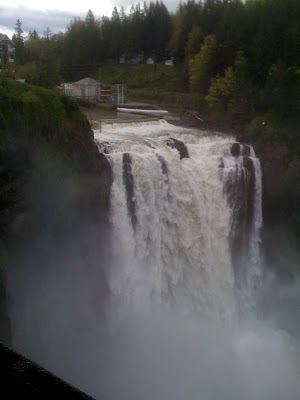
This week, I have been studying hazard mitigation in the city of Snoqualmie, WA and today we were given a tour of the tiny city by the mayor and other officials who shared their knowledge regarding the city's preparation for the next big natural disaster.

Around 10am (after the caffeine had kicked in) I began to draw parallels between what I was hearing and what I had seen in Albuquerque when the floods hit a few years back. A visitor of China asked the question, "Why did the natives of this city settle in this flood-prone area in the first place?" I sorta chuckled when he asked this. But I didn't expect to hear the answer the gentleman received. Apparently, this area was not historically susceptible to flooding until the logging industry ran amok in the surrounding mountains. Interesting. Go on you say? The forests were ravaged to such an extreme that storm runoff had increased enough to make that drastic of a change to the environment.

So, the mice in my head began to run and I thought, "Hrm, could maybe, just maybe, the runoff situation in Albuquerque be the result of an increase in urbanized area?" Could we have built up the our roadways, sidewalks, and homes to the point where we have increased runoff so that our storm system actually reaches capacity with less effort?

I don't know about you but I'm suddenly intrigued with hazard mitigation and the ways in which we can use natural processes and nature-sensitive technologies (don't I sound like a hippy?) to cure the problems we have created through naive manipulation and false confidence?

The city's form of development has been so greatly affected by homogenization and generic growth to the point where our innovation has seemingly been forgotten. But alas, there are solutions. These solutions are so very simple, yet they require everyone to change the way they were taught to do things...and that's the harddest part.

Rapid Ride


Seattle has just introduced a new fleet of BRT busses also called "Rapid Ride" with the same livery we've come to know. These would look quite sexy zooming down Montgomery, San Mateo, and Coors.

Monday, April 27, 2009

ABQ's "Burgeoning Bike Scene"

Albuquerque has been named as one of the top cities for burgeoning bike scenes! A quick rundown of the top cities and their statistics shows that we definitely have the infrastructure - nearly 400 miles worth. But we lag in percentage of commuters. Hopefully the new I-40 ped/bike bridge will help us close the gap with peer cities. The article.

Tuesday, April 21, 2009

Urban Design Fail - Lomas & Broadway

The corner of Lomas and Broadway now includes a gas station, drive through restaurants, and a dirt detention pond with surrounding chain link fence. How's that for a gateway into our revitalizing downtown? *shakes head*
KOB story link.

Thursday, April 02, 2009

BikeABQ

I am ecstatic about the bike boulevard and ped/bike bridge over the river as seen here and here. Soon we'll be talking about separated bike lanes like these. I'm thinking of Carlisle, parts of Central, parts of Lomas, 4th, and Rio Grande. Perhaps the Great Streets Facility Plan would be a perfect place to implement a test case? I find it incredible that people question the use of $7.5 million for a pedestrian/bike bridge when hundreds of millions of dollars are spent annually to subsidize oversized roadways throughout the city and particularly at the fringe. But then again, Marty isn't looking to set the record straight, he has another term to run for in the meantime. A nifty video about separated bike lanes...

Thursday, March 26, 2009

Affordable Lofts


I'm not sure how long these have been completed but I'm a little surprised they aren't filled as of yet. I only wish the developer had scrapped the parking lot and built urban townhomes along the street. Affordable for those just starting a career or looking for simple digs. Bell Trading Post Lofts

UNM On-Campus Housing


Finally, it is happening. Ok, well, not physically but the details are being ironed out according to this article. I hope they intelligently locate these buildings (hopefully multi-story, mixed-use) along Central Ave. or Lomas. The parking situation for UNM is out of control and locating dense housing near campus is key to enhancing the area in several ways. First, students who don't need to pay for automobiles will add to the vibrancy of the walkable neighborhood and take another vehicle off an already congested roadway system in the area. Also, students that don't need to pay for vehicles will have more spending money to support local businesses. Finally, this supports my desire to take over the world.

In the screenshot above, it is clear we have a horrendous pedestrian environment on the edge of our flagship university. With Nob Hill a block back and UNM retail a block ahead, this intersection screems for help. We can connect the two areas with very little effort. Locating student housing along Central in this area will go a long way toward realizing a decent pedestrian environment.

Yay for change.

Thursday, March 12, 2009

The Seattle Model


Having lived here for almost three months now, I have found it more difficult to relate the built environment of Albuquerque with the Seattle area. Dallas seemed much easier to compare. The relatively flat landscape, the pretty skyline but sleepy downtown, and the prevalence of suburban neighborhoods. Maybe it's the trees and varying geography of the Pudget Sound region? One thing that has shocked me, however, is the strong ties I have seen between my beloved Duke City and the Emerald City. First there is the empty box from Los Poblanos in the basement of my building at the UW. Next, there is the plethera of Land of Enchantment license plates. So many in fact, I'm pretty sure I have seen more NM plates here than I did when I was in Dallas. This fact shocks me considering Dallas is 1/3rd as far as Seattle. What was my point? Oh right, relationship.

Albuquerque seems to be right on the fence when it comes to economic and social issues. As a 20-something in Albuquerque, I tended to find other liberal, environmentally conscious, atheistic, gen x'ers which the Northwest is known for having in large quantities. Coupled with a rather sizable population of REI members who were ready to get out of the city to soak up some mountain and river goodness when there was free time to be had. But still, there was always an obvious presence of conservatism and almost Texas-like economic development defined by cheap land.

After my first quarter of courses, something I have learned is that a city represents the values of its inhabitants. I'm not sure how I feel about this given our overabundance of strip malls and parking lots. Our sleepy downtown. Our multi-nodal city with little to no relationship and seemingly zero planning. Too often I read about the local pride in our low density growth pattern that reflects the far-as-the-eye-can-see geography. These facts illustrate an abundance of opportunity for improvement. But what exactly are the values of the community?

While Seattle appears to be a pioneer of healthy, urban initiatives, it has quite a colorful history of political and social struggles. While the city claims to be diverse, it is similar to Albuquerque in that it's predominantly a bi-cultural city. The city actually has a quiet history of segregation. Until more recently, economic booms have tended to aid in the city's ethnic cleansing, if you will. Additionally, many people forget how spread out metro Seattle really is. The suburbs stretch north and south quite a long ways with typical low-rise sprawl. But this is hardly noticeable from the city proper where you're surrounded by dense, Capital Hill, Queen Ann hill, and the Sound. Much of this area is easily accessible by bike and by bus and much of it appears clean, safe, and again, dense.

As with every region in the country, and world, Albuquerque now has the opportunity to lay the framework for smarter, future growth in this slow economy. But this framework must be defined by the same community that has provided much of what we know as our ABQ. While the RailRunner provides the incentive and backbone for a positive shift, it remains to be seen if we've learned from our past. The knowledge of a warming atmosphere and straining natural resources exists. But will we choose a more equitable, livable, and environmentally sustainable form of development?

Models like Dallas, Denver and Seattle are prototypes for us to study our likely future. Each one of them is a dim reflection of our eventual city. So, instead of choosing to be stubborn and going through the growing pains of traffic congestion, social stratification, smog, etc., why can't we jump straight to the solutions these cities have begun to embrace?

Thursday, February 26, 2009

Santa Fe Baboons

No to domestic partnerships and yes to subsidizing sprawl. I'm not disappointed to be a resident of another state on this eve.

Monday, February 23, 2009

The International District


Jim Scarantino wrote an excellent piece in the Journal about the former "War Zone" that I believe deserves kudos. I have to credit the mayor to some extent for his effort to revitalize this neighborhood. But, ultimately, it is the residents of the International District that we should applaud. Hopefully we will see some investment from the city in terms of urban design aspects like pedestrian crosswalks, shade trees, and wider sidewalks to encourage complimentary commerce.

Friday, February 20, 2009

Casa District


I'll save my usual harangue regarding the housing/regional transit station transition and, instead, focus on the nascent district. A form is emerging that I'm, increasingly becoming fond of.
It's not the density an urban fanatic dreams about. However, the density in these three new projects will likely result in 500 or so residents within three blocks. The open, remaining half block may even be that 6-8+ story residential building we're all anxiously awaiting. My mood: hopeful.

High-Speed Rail


Ok, I feel better after my previous post. The article. Imagine a train like this parked at the ATC awaiting passengers heading to Denver.

Note there is no HSR currently planned for ABQ. Not good. It would appear that the Front Range/Intermountain West has work to complete. Missing out on this type of infrastructure would be akin to missing out on the interstate highway system.

Wednesday, February 11, 2009

Did Someone Say Shovel Ready?

Borrowed from the NY Times

Note the picture: Our savior president standing in front of the construction site for a...wait for it...parkway.

What a crock. Explain to me how sending money on projects like a third lane for I-25 will produce long term economic affects that aren't negative? Now tell me that spending stimulus money on pie in the sky projects like a streetcar or (gasp) arena won't produce lasting, positive effects? Not so pie in the sky when you boil it down. Apparently school construction isn't logical, either.

Watching our leaders salivate over this money to cover short term projects that didn't fit their anemic, annual budgets is quite embarrassing. I hope I'm wrong about this. I know there are worthy projects in this jumble but labeling this "forward-thinking" or to even comparisons to the New Deal are absurd.

Speaking of absurd, what's with the vote of no confidence for Shmidly? UNM employees appear to have trouble with change. How many leaders will they oust in an attempt to keep the status quo? (Perhaps I know too little to comment)

Saturday, February 07, 2009

Marty for Downtown and MRCOG Says What?

Image courtesy of kevinkarnsfamily

I was happy to hear Mayor Marty endorse the city center this week. I can't find the link but I either read or heard him (news clip?) suggest that it would be good to obtain funds that could be spent downtown. Not the strongest statement but we'll take what we can get. I'm certain he was referring to money for a canopy for the ATC but I'm not sure what else he might be referring to knowing that money won't come from DC for the arena or streetcar.

While the city has minuscule amounts of money funneling down from new housing construction in the 'burbs, perhaps we'll see a return of serious talk concerning inner city development and density? For some reason I'm skeptical.

During my visit over Christmas I noticed some work has been completed on the last remaining building at old AHS. Does anyone have any information about that project? I know it's not part of Rob Dickson's development.

Speaking of Rob Dickson, anyone have a clue what he's up to now that his project is fully built out?

In other news...

Now, I have ranted and raved about the Railrunner and I can't help but add more fuel to the fire. My textbook contained some information that I felt was pretty obvious but it doesn't seem to make sense to so many:

"Transit's cost effectiveness increases with higher densities at origins and destinations. It is no surprise that public subsidies for transit have increased at the same time that metro transit is not as competitive as private automobile."

"A new rail system implemented in an area laden with density caps and minimum parking requirements will have less influence on land development than such a system implemented in areas where the community wide land use design, small area plans and development management plan include actions intended to support or leverage the opportunities provided by the investment."

"transportation plans either reinforce past development trends or stimulate development in locations not contemplated in the land use plan."

After reading this I immediately thought of Nob Hill fighting a streetcar and the horrendously planned (or lack thereof) Journal Center station area.


I also often wonder who is making recommendations to add more stops to the system. I heard talk of creating an additional stop at Montano. Really? Talk of a fourth station in Santa Fe seems incredibly asinine considering the ABQ metro area currently has just 6(see population differences between SF & ABQ) stations. Throw in the pueblo stations (don't get me started on these) and we've killed the purpose of commuter rail. The chance of MRCOG actually convincing citizens to ditch their gas guzzlers in favor of the system requires a huge convenience factor. Added commuting time plus limited service is not the answer. MRCOG is mixing the concepts of commuter rail with light-rail while leaving everyone wondering what they're doing because they don't appear to have transparency in their planning nor their execution.

Overall, this in a beautiful concept and project for the metro area. But the execution is what matters most. My confidence has been shaken.

Sorry for the brain vomit style of my post.

Monday, January 26, 2009

A New Year, a New Chapter

I hope the new year finds everyone well. Aside from the new year, the new administration, and the economy, I find myself relocated to the City of Seattle where I have begun my transition from engineering to the field of urban planning. Long ago, I decided that my blog was more than a past time and I was dedicated to becoming an integral part of the urbanization movement taking place the world over. I intend to obtain the necessary tools to effect positive changes in the urban environment wherever I end up in the future. Those that know me know that my heart remains in Albuquerque and that I hope to one day play a vital role in shaping the city. Unfortunately, due to my absence, I will be unable to update UrbanABQ as often as I would like. I do, however, intend to relate some of my coursework and revelations to the Duke City. And with that, here's wishing everyone a healthy and prosperous 2009.

Thursday, December 25, 2008

Happy Holidays


Here's wishing everyone a wonderful holiday season.

Tuesday, December 09, 2008

MR COG and Urban Transit-Oriented Villages


This is tentatively planned for the often touted Airport Station. It will be incredible to see the changes take place in this area over the next decade with Mesa del Sol and this urban village.

I am sitting in Seattle at the moment pondering the eventual growth of my beloved Albuquerque as it relates to Seattle. One word: DENSITY.

This city is littered with neighborhood retail in the city proper. Practically 100% void of any strip retail that our city "thrives" on for tax revenue. Seattle citizens have largely voted against the type of development that plagues our city, choosing, instead, a socially progressive, environmentally friendly, aesthetically pleasing urban form. It is up to us, as citizens, to get involved and become educated on how our built environment effects our lives. The baby boomers are luke warm to mixed-use urbanity, Gen X'ers are catching on, and millenials will know little else from the dense urban form. It is what today's younger generation is drawn toward.

Ultimately, the market will dictate and we'll be left with predominantly sprawling suburbs as exists today barring some massive economic boom (and skyrocketing gas prices) that seems to be elusive to our city. However, our future is in dense villages and multifamily units along transit routes. It may not be today or tomorrow but it will come. We can be proactive or reactive. The reactive approach is what got us into this mess. You choose.

Sunday, November 23, 2008

MLS in the 505

Photo courtesy of Flickr user: swilsonmc

The governor has changed his tune and gone back to Expo NM with plans for an equestrian facility. Great. Now what about the remaining 200+ acres of highly unused land? As I have posted previously, I do not believe it to be in our best interest to continue with the fair as it currently exists. Between the Downs relocating to Moriarty and Tingley Colisseum becoming irrelevant, nearly half of Expo NM land will remain unused.

From above, it is glaringly apparent that a majority of the unused space lies along Central Ave. and Luisianna Blvd. Would this area not be best used by complimenting the city's efforts to strengthen the international district and redevelop Central Ave.? In addition, this could create a district of transit-oriented development that would likely compliment a rail line to connect downtown and uptown. I'm talking dense, walkable development with offices, residential and even some industrial space. This could reasonably be done while still maintaining the existence of the fairgrounds, if so desired. The lost parking spaces could be replaced with above and below-grade, multi-level garages.

Additionally, the main point of this post is to address the need (ok, want) for Major League Soccer. Imagine a regional park with soccer and baseball fields as well as an MLS stadium. This could be New Mexico's only chance to obtain a major league sport and soccer happy Albuquerquean's are likely to support such a team. I stumbled upon an article that lists the Duke City as a potential candidate for an expansion team. Granted, the article discusses expansion of a USL-1 franchise but I bet an argument could be made for an MLS team. And while the governor is attempting to solicit ideas for Expo New Mexico, now would be the perfect time to move ahead with efforts to secure a team. The article states, "A short list of markets from which we believe a USL-1 franchise could be successful with the proper ownership and venue include, but are not limited to (in no specific order): Omaha (NE), Tulsa (OK), San Antonio (TX), Tampa (FL), Phoenix (AZ), Boise (ID), Oklahoma City (OK), Albuquerque (NM), Memphis (TN), and Birmingham (AL) We are currently in advanced discussions with interested parties in several of these markets."

The stadium would be a sizeable catalyst for redevelopment to the area as it would attract approximately 15,000 fans (league average) to the stadium for 15-20 events, annually.

We have so, so, so much potential if we could just realize it. Where are the leaders, such as Mayor Tingley, with the vision?

Thursday, November 20, 2008

What's Not To Love About This?


I am sold. Transit oriented entertainment. What other city has the opportunity to do this? After reading the report explaining the reason for a 10,000 seat arena, I've decided I would be fine with a 12,000 seat venue...with expansion capabilities of course. The arena architecture is a little weak. I also think retail and taller residential is needed on Broadway. Kudos, design team!

Monday, November 17, 2008

Transit Oriented ABQ


The Rio Grande Foundation (NM's version of the CATO Institute) has been given significant opportunity by the local press to bestow their "research" and "wisdom" upon the citizens of our state and region. Their libertarian slant and anti-taxation preaching, however, adversely clouds their judgement. Americans, in general, are highly likely to rebel against high taxes. So when plans for mass transit and a publicly financed downtown arena were announced, it was no surprise that they immediately pushed back with their agenda.

Before the transit vote, Paul Gessing, the current President of the Rio Grande Foundation, was a guest on Eye on New Mexico to tell us what a waste of money it would be to approve such a tax. He even conjured up scenarios for which the project was ineffective. Naturally, he used a worst case scenario. But while his argument immediately sounded rational and pragmatic, it ultimately failed to recognize the full cause and effect of the project.

Quietly and void of the fanfare of the librul (ha) media, towns up and down the commuter rail line have implemented plans to create vibrant, walkable town centers and villages around their RailRunner stations. These areas will eventually house tens of thousands of citizens whom will have the option to move about the metro area by public transit. This seems like such a foreign idea today but it will become the norm in decades to come.

Missing from the argument about this tax was the discussion of future generations ability to live sustainably and with transit options. It is about changing our lifestyles to reflect a rapidly changing urban reality. This tax was every bit about how our city will balance fringe growth with infill. The mayor and MRCOG need to stress this idea to get everyone on the same page because the current, [do it because it's good for us] argument is a tougher sell.

I'm proud of the citizens of the middle Rio Grande region for supporting this tax as it will further improve our transit systems. It will be interesting to see how this arena project will unfold. Will the city be able to sell the voters on the project or will Paul Gessing's misleading research combined with the city's marketing inabilities be enough to keep the project grounded, yet again?

Tuesday, November 04, 2008

Yes We Can


An historic day I will never forget. Just 77 days till change.

Wednesday, October 29, 2008

VOTE TO SUPPORT MASS TRANSIT


Originally uploaded by ABQturkey
It's disheartening to hear citizens say they don't support a tax that subsidizes an expensive "thing" they don't use. I am at wit's end trying to explain to them how roads are not the solution and how they are subsidized by everyone. US citizens have been trained to think that mass transportation is only "for poor people."

In reality, this project might be the most progressive "thing" our humble state has done in ages. In cities all around the country, they are studying how we were able to produce such a potentially catalytic, infrastructure project for such a terrific price. In New Mexico, we still think hundreds of millions of dollars is a lot of money. Not that it isn't, however, metro areas across the country are investing in major public projects such as commuter rail and light rail for dollar figures that make ours look like a toy train.

This isn't about any one individuals route to work or Wal-Mart (don't get me started on Wal-Mart). It is about modifying our growth patterns. It's about options. We wince at the thought of a $10 million budget to fund a major mass transit artery, yet we cheer on interstate interchanges that cost $90 million (Coors & I-40), $300 million (big I), and soon, $250 million + (Paseo & I-25).

Thursday, October 23, 2008

Arena Renderings Galore

Thanks to Sarah Dolk's Duke City Fix blog, we have what we have all been waiting to see. This is an arena and site plan I can get on board with! A beautiful hotel tower (looks to be near 30 stories) and plentiful public space with a water feature and outdoor public seating.

A rather hard-to-envision rendering of public space on the west side of the train tracks with the arena in the background.

Here, they show a parking garage built behind condos along Broadway Blvd. This is the only viable solution, I believe, as it provides the necessary parking along with residential development as a buffer to the East Downtown nabe. The only problem I see is a rendering with 3-story tall condos and zero retail space lining Broadway. Weak.

Finally, the arena is shown with un upper level, but still with only 12,000 seats. Overall, I think this is a terrific plan given the tight space in the area. The hotel tower might be one of the most attractive hotel towers I have seen in most cities doing similar projects. It looks very similar to the W Hotel here in Dallas. Could we be getting a W? The frequently asked questions section does reveal that everything is still being studied and things can change, including arena size. And with that statement, I am satisfied for now.

Nationwide Arena


Nationwide Arena
Originally uploaded by DRust
A terrific example of arena related development, successfully executed by a public/private partnership. I'm quite certain the city needs to take a more proactive role in the actual goals of the plan in terms of layout and surrounding development. There is a need for public spaces in downtown Albuquerque and this project presents opportunities to create exciting urban spaces that can potentially be as iconic as the arena itself.

Tuesday, October 21, 2008

Rendering Good Times

Due to all this canceled/stalled building talk, UrbanABQ has decided to take a moment (or 5 hours) to dream a little. I used a couple of very recognizable buildings, can you name them? I also took the liberty of placing what I believe to be more appropriate building types at the old greyhound bus station site. Next, I contemplated what to do with the area around the Westin hotel but I couldn't find any rendered, low-rise buildings that would resemble urban retail so I left it alone. Peruse at will.

Monday, October 20, 2008

Say It Ain't So

Packard Place is officially dead, according to Blue Dot Corporation's, Garcia. I think it would be safe to say Chant Tower is permanently on hold as well at this time. I'm quite certain the only opportunity that this city has to see a high rise built is if the arena gets built.

Note to the city of Albuquerque: 12,000 seats is superbly insufficient. We're a larger market than Des Moines, Wichita, Tulsa, Grand Rapids and soon, Omaha. In a best case scenario, this glorified gym will take two years or so to be constructed. By then, the metro population will be pushing 900,000 and our trade area will be pushing 1,050,000 million when accounting for the Santa Fe market. Furthermore, these buildings have a lifespan of 25-40 years. By providing a 12,000 seat arena, it suggests we'll never be major league worthy? Apparently I'm not seeing something...

Arena porn:

Kansas City:

Tulsa:

O! ...maha
In a future post, I'd like to discuss the Rio Grande Foundation's so called "think tank" and their leader, Paul Gessing. Does anyone have any information about "that one"? If it were up to him, we'd never build a thing as long as it was payed for with taxes. Perhaps we should privatize schools....

Monday, October 06, 2008

They're Invading!


It was bound to occur. Even the NIMBYs of Nob Hill couldn't fight the inevitable. Did anyone think Jason Daskalos and his team would aim for locally owned shops and provide them with affordable rent? (He has to pay those lawyer fees somehow!) Now if we can only get Apple to relocate and H&M to locate here. Nob Hill has arrived, folks. The NMBJ article.